

We’ve all heard of herbs, but they’re used in so many different ways. Herbs can be food, seasoning, or medicinal. In the West, most herbs are used as single ingredients and prescribed in similar ways to pharmaceuticals. Traditional Chinese Medicine (TCM), in contrast, has its own unique herbal system.
Herbal medicine has been an integral part of TCM for nearly 2,000 years. The first published materia medica, the Shen Nong Ben Cao Jing (Divine Farmer’s Materia Medica), dates to the first or second century CE.
Since then, herbal medicine has been used in China on its own or alongside acupuncture. Chinese herbs are mostly used in formulas that combine 2–15 herbs. They can be applied in a variety of ways.
Table of contents
- How Do Chinese Herbs Differ from Acupuncture?
- Theory and Principles of Traditional Chinese Medicine
- How are Chinese Herbs Administered?
- Different Types of Herbal Powders
- Different Types of Topical Herbal Formulas
- Chinese Herbs are a Safe and Effective Way to Boost Your Health
- What do Chinese Herbs Treat?
- Chinese Herbs Can Help Treat Chronic Conditions
- Common Questions About Taking Chinese Herbs
How Do Chinese Herbs Differ from Acupuncture?
Chinese herbal medicine is different from acupuncture in that it adds medicinals directly to the body, while acupuncture is focused on harmonizing what is already present. Depending on the condition and person being treated, this can often make the difference in recovery.
Theory and Principles of Traditional Chinese Medicine
Balancing Your Body’s Internal Climate using Herbal Medicine.
Chinese herbs are generally prescribed according to something called Zang-Fu theory. Zang-Fu theory is a description of the body’s internal organs. Zang organs are more Yin and Fu organs are more Yang.
The interaction between Yin and Yang organs creates our body’s internal climate. Early philosophers described the body’s internal climate as mirroring the external environment. So when you hear TCM diagnoses described they usually use words that also describe the environment like wind, cold, damp, dry, and heat.
In broad strokes, disease and dysfunction in the body stems from improper balance in the internal climate. For example, if there is more Heat in the body, then Cold herbs can be given to “cool” the Heat. If both Heat and Cold are present, then harmonizing herbs might be chosen to guide the system back to homeostasis.
Both herbs and acupuncture can be used to re-balance the internal climate. Which therapy to use depends on the practitioner. Once the diagnosis is established and herbs are chosen, a traditional formula can be selected as a general guideline, then modified to fit the patient.
How are Chinese Herbs Administered?
Traditional Chinese herbal medicine can be administered in several different ways. Internal consumption is the most common form of delivery, but different types of topical applications can also be used depending on the issue.
Historically, herbs were given internally as pills or decoctions.
Decoctions are made by boiling raw herbs in water, straining out the liquid and taking it over a day or two.
Pills are made by grinding the raw herbs into a powder or paste then rolling them into pills. In the modern day, herbs are still given in those traditional forms but also in powders/granules as well as other types of pills.
Different Types of Herbal Powders
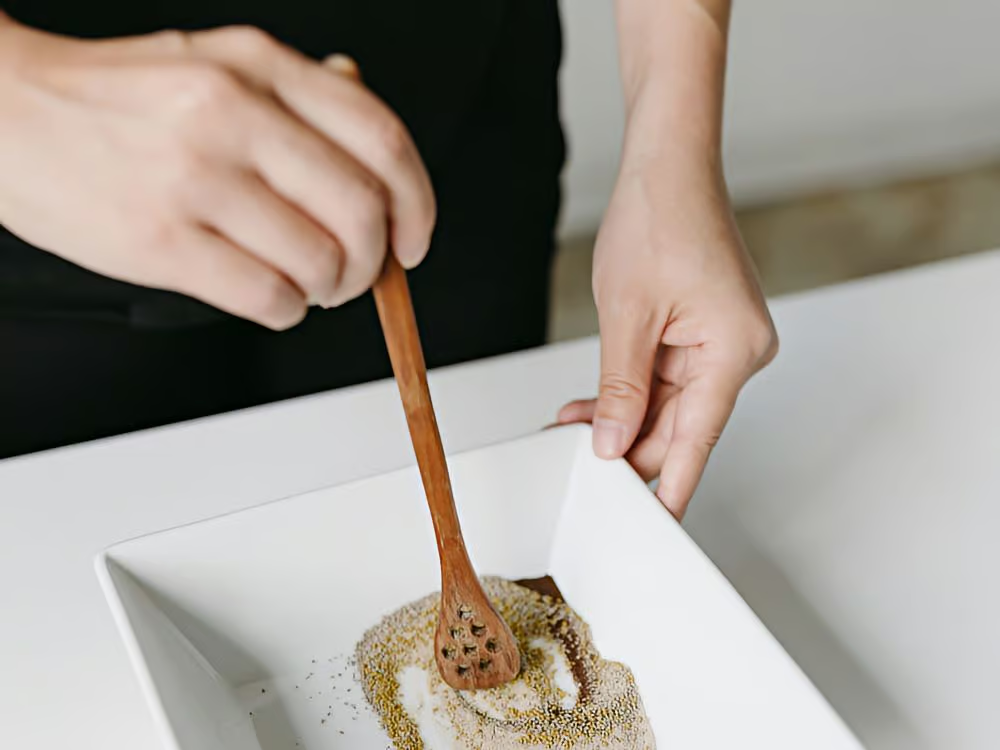
Herbal powders, also known as granular herbs, are essentially an instant-coffee version of decoctions. They are made by reducing the liquid from a decoction into a concentrate, then spraying that concentrate over a binder to make a powder or granule. The only difference between powders and granules is the size of the resulting product.
Powders are generally finer, while granules are coarser. Pills made traditionally where the raw herbs are ground and combined are most commonly available as tea-pills. Tea-pills are easily identified because they look like little black BB’s.
The other types of pills available are usually made from herbs that have already been decocted and made into powders. These kinds of pills are capsules filled with powder or tablets made of compressed powders.
The efficacy of these types of pills is relatively similar, so the type used depends on practitioner preference.
Different Types of Topical Herbal Formulas
Topical herbal formulas take the form of plasters, pastes, creams, or liquid soaks.
Plasters are most commonly used as a topical pain treatment, though they can also be used to treat certain skin conditions.
Pastes are made from ground raw herbs or by mixing powders with water and can be applied to the skin surface. We use these for acne spot treatments or certain inflammatory conditions like mastitis.
Creams are usually manufactured formulas designed to treat something specific, like a topical cream for burns. In Eastern countries herbs are often combined with pharmaceuticals in creams for mutually enhanced effects.
Liquid soaks are usually just herbal decoctions that are applied externally. They can be added to baths or used to treat different foot conditions or as topical delivery methods for genital-urinary issues.
Chinese Herbs are a Safe and Effective Way to Boost Your Health
Herbs are also a safe form of medicine. As with any medicine, high doses can be toxic, but when administered by a trained practitioner, the risk is very minimal. Side effects with herbal formulas are also very rare and can usually be mitigated by changing the formula.
Some preexisting conditions, medications, or pregnancy can affect what herbs can be safely taken so always tell your practitioner what you are taking as well as any recent changes to your overall health.
What do Chinese Herbs Treat?
We’ve already mentioned a few different conditions that can be treated with Traditional Chinese herbal medicine, but there are many more. The simple answer is that Chinese herbs can be used to treat almost any condition, similar to acupuncture.
Colds, sinus infections, coughs, and stomach flus can all be effectively treated with Chinese herbs. In the era of COVID, it is important to mention that you should always go to your doctor and get tested if you suspect you have a contagious illness. Regardless of the test results, herbs can still be helpful. If you do have an acute infection, just wear a mask when you come in.
The key with acute conditions is to take herbs as soon as possible. You can avoid head colds and similar illnesses with the right formula at the right time. If you are already sick, then herbs can speed recovery and alleviate symptoms.
Some acute injuries can also be treated with herbal medicine. Sprains, strains, and other soft tissue injuries can be treated both internally and externally with herbs. Healing fractures can be supported with Chinese medicine, but as with COVID, you should always check in with your doctor first to rule out any serious injuries.
Other acute, but non-infectious conditions can also be treated with Chinese herbs. There are many excellent formulas for use in the treatment of menstrual related symptoms (both physical and emotional), headaches, burns, and many other maladies.
Chinese Herbs Can Help Treat Chronic Conditions
Chronic conditions are more common to see in a clinical setting. Most are non-infectious and can involve an immune system function or some essential aspect of the body that isn’t functioning properly, like sleep or digestion.
Seasonal allergy treatments are also a very common use of herbal medicine. Herbs can be given for the prevention of allergies or for symptoms.
Herbs can also be given for:
We’ve also had success in treating some chronic inflammatory conditions like ulcerative colitis, irritable bowel syndrome, eczema, acne, etc.
Herbs can be used to treat as many conditions as acupuncture, which is to say, most of them. Ask us about herbs next time you come in!
Common Questions About Taking Chinese Herbs
Ready to Give Herbal Medicine a Try in Washington DC?
Whether you’re dealing with colds, GI issues, or injuries, Cherry Blossom Healing Arts provides personalized, evidence-informed herbal medicine care in Washington, DC. Our acupuncturists are all nationally board-certified in acupuncture and herbal medicine and licensed to practice in Washington, DC.
To get started, head to our booking page and schedule your first appointment. If you’d like us to check your insurance benefits, we’d be happy to take care of that for you. We are in-network with CareFirst/BlueCross and Aetna.
About the Author

I find working as an acupuncturist to be truly inspiring, and am excited to come to work each day. I consider myself to be an integrative practitioner, and while I focus on Chinese medicine, I also incorporate Western medical concepts to best serve my patients.